
Indoor vs Outdoor Digital Signage: Planning the Right Network
A practical Australian guide to indoor vs outdoor digital signage with onQ advice on hardware, CMS workflow, rollout governance, measurement and support.
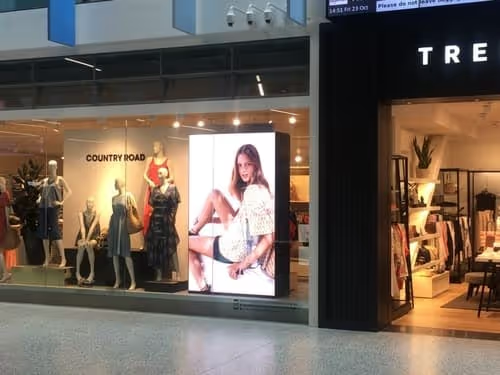
Indoor vs Outdoor Digital Signage: Planning the Right Network
Indoor and outdoor digital signage use the same broad technology but are specified very differently. The screen, cabinet, brightness, mounting, cabling, power, maintenance access and content strategy all need to match the environment. A display specified for indoors will fail outdoors. A display over-engineered for outdoors wastes budget when placed inside.
This page covers the key differences between indoor and outdoor digital signage, how to plan a network that uses both correctly, and what to check before specifying either.
The fundamental differences
The most important differences between indoor and outdoor digital signage are brightness, weather protection and heat management.
Brightness is the most visible difference. Indoor commercial displays typically run at 500 to 2,500 nits. Outdoor displays need 3,000 to 10,000 nits or more to remain legible in direct sunlight. A standard indoor screen placed outdoors will look washed out and unreadable in bright conditions.
Weather protection is essential for outdoor displays. Rain, humidity, dust, insects and temperature extremes all affect outdoor hardware. Outdoor displays need enclosures rated to at least IP65, meaning they are protected against dust and water jets from any direction.
Heat management is critical for outdoor LED and LCD. Australian summer conditions can create ambient temperatures that exceed the operating range of standard indoor displays. Outdoor enclosures need ventilation or active cooling to keep the display within its rated operating temperature.
Indoor digital signage planning
Indoor digital signage covers a wide range of environments: retail stores, corporate lobbies, shopping centres, automotive showrooms, hospitality venues, universities and healthcare facilities. Each has different brightness requirements, space constraints and content needs.
For most indoor environments, commercial LCD is the practical choice for individual screens and small arrays. LED video walls are specified where scale, seamless display area and high visual impact are priorities. Indoor LED can be specified at finer pixel pitches than outdoor LED because viewing distances are shorter.
Outdoor digital signage planning
Outdoor digital signage is used for building facades, retail park directories, car park entries, forecourt signs, venue exteriors and large-format advertising locations. The specification starts with the environment, not the content.
Site reviews for outdoor digital signage should cover: direct sunlight exposure at different times of day, wind load requirements for the structure, power availability and cable routing, service access for maintenance, and any council or planning approvals required for the installation.
Semi-outdoor environments
Semi-outdoor locations are the most commonly misspecified. A covered forecourt, a shopping centre car park entry, a building awning or a partially glazed atrium may receive significant sunlight and heat without being fully exposed to rain. These locations need higher brightness than standard indoor displays and may need weather-rated enclosures even if they are not directly exposed to precipitation.
onQ reviews semi-outdoor locations carefully before specifying hardware because the conditions that affect screen performance are often not obvious from a quick site visit. Time-of-day sunlight, reflected light from nearby surfaces, seasonal temperature variation and local wind patterns all affect the right specification.
Specification comparison
| Specification factor | Indoor | Outdoor | Semi-outdoor |
|---|---|---|---|
| Brightness | 500 to 2,500 nits for most applications. | 3,000 to 10,000+ nits depending on sunlight exposure. | 1,500 to 5,000 nits depending on site conditions. |
| Weather protection | Standard indoor protection. IP20 or similar. | IP65 or higher required. | IP54 or higher usually appropriate. |
| Heat management | Passive ventilation usually adequate. | Active cooling or ventilation required in hot climates. | |
| Pixel pitch (LED) | P1.2 to P4.0 for most applications. | P6 to P16+ depending on viewing distance. | P3.9 to P8 depending on distance and light. |
| Content | Detailed visuals, product content, motion graphics. | Large typography, high contrast, short messages. | Higher contrast than indoor. Shorter messages than standard indoor. |
| Maintenance | Front-service LED options available. LCD panel replacement standard. | Rear or front access depending on structure. Service plan critical. | Service access needs to account for structural constraints. |
Mixing indoor and outdoor in one network
Many commercial digital signage networks include both indoor and outdoor displays. A retailer may have outdoor entrance signs and indoor store screens. A shopping centre may have outdoor car park signage and indoor centre court displays. A corporate campus may have exterior wayfinding and interior lobby screens.
onQ manages mixed networks by specifying each display type to its environment and connecting all displays through the same CMS. Content can be scheduled independently for each zone while the support team monitors all devices from one platform.
Frequently asked questions
Can the same CMS manage both indoor and outdoor screens?
Yes. onQ CMS manages both indoor and outdoor displays from the same platform, allowing different content schedules and monitoring across all screen types.
Do outdoor LED screens need council approval in Australia?
In many cases, yes. Outdoor LED signs that are visible from a public road or that exceed certain size thresholds may require development approval. Requirements vary by state and local council. onQ reviews approval requirements during the site planning stage.
Can indoor screens be used in a covered outdoor area?
In most cases, no. Covered outdoor areas still receive sunlight, heat and humidity that can damage and degrade standard indoor screens. onQ recommends semi-outdoor or outdoor-rated displays for any location that is not fully enclosed and climate-controlled.
Enjoy our insights? Add onQ Digital as a preferred source on Google to see more of our content in your search results.


Ready to start a conversation?
Speak with our team about digital signage, CMS software, or retail media infrastructure. We’ll help you scope, design, and deploy the right solution.

Digital signage, CMS software, retail media platforms, analytics, and managed services across Australia.
© 2026 onQ Digital. All rights reserved. Website by D&n