
LED Signage for Retail Stores
A practical guide to LED signage for retail stores, covering shopfronts, promotional zones, CMS control, retail media and onQ display pathways.

Why led signage for retail stores matters
LED Signage for Retail Stores gives retailers a more flexible, higher-impact way to present products, campaigns and brand content inside the store. Unlike printed POS or standard LCD screens, LED signage can scale to architectural proportions, update instantly and connect to a CMS that manages content across multiple store locations at once.
Retail LED signage now serves two distinct purposes. The first is brand and campaign presentation: creating stronger visual moments at entrances, feature zones, fitting rooms and department boundaries. The second is commercial: turning high-attention screen positions into advertising inventory that can carry supplier-funded content alongside owned brand campaigns.
LED display formats for retail environments
Retail environments use different LED display formats depending on the store type, zone and audience.
Indoor LED video walls are the highest-impact format for retail. They suit entrance features, department feature walls and large-format campaign zones. A well-specified LED wall gives a retailer a display surface that feels designed into the store rather than added afterwards.
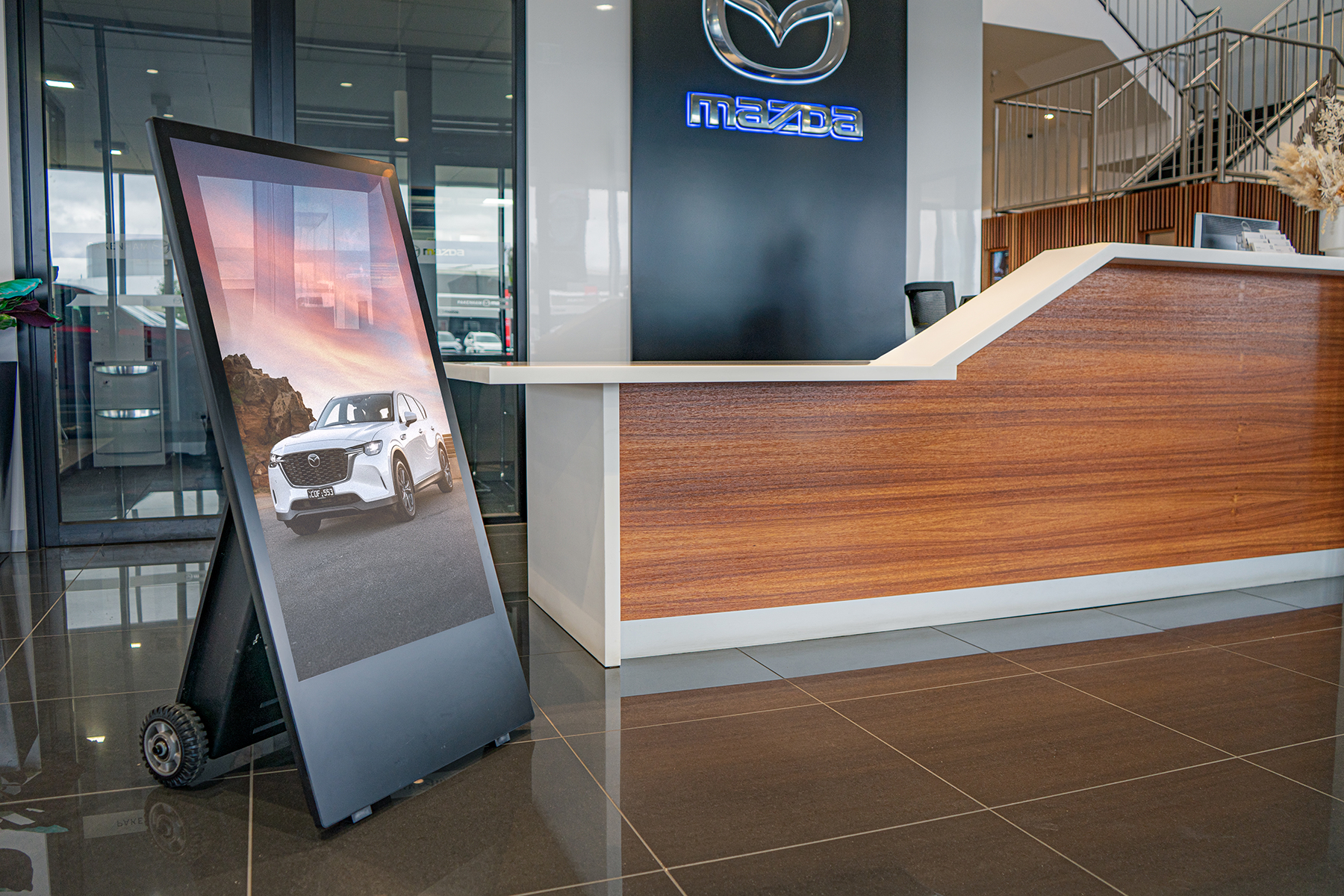
Freestanding LED posters and totems are used in aisle locations, promotional zones and pop-up positions where a fixed installation is not practical. They are flexible and easy to reposition without structural changes.
Transparent LED film and panels suit shopfront windows and glass facades where the display needs to attract street attention without fully blocking the interior view. Transparent LED is increasingly used in fashion, beauty and lifestyle retail where the shopfront experience is part of the brand.
LED MIP and specialty formats suit luxury retail, gallery environments and brand installations where the display needs to work with architectural detail rather than sit on top of it.
How onQ delivers LED signage for retail stores
onQ manages LED signage for individual flagship stores, multi-site retail groups and national rollouts. The process covers site assessment, hardware specification, installation, CMS configuration and ongoing support.
Site assessment reviews the store layout, sightlines, ambient light, power access and any landlord or centre management requirements. Retail LED installations in leased tenancies often require landlord approval and must work within the constraints of the fitout.
Hardware specification matches the display type, pixel pitch and brightness to the site and the retail environment. A luxury fashion store has different requirements from a supermarket or home improvement warehouse, and the specification needs to reflect that.
Installation is managed to minimise disruption to trading. onQ coordinates with the retailer, building services and any centre management to install displays cleanly and on schedule. Many retail LED installations are completed overnight or across a short trading window to avoid impacting customers or staff.
CMS configuration connects each LED display to the onQ CMS. For multi-site retailers, this means a single platform for managing campaign content across all locations. Individual stores can receive central campaign content while retaining the ability to carry local content within approved zones.
Ongoing support includes remote monitoring, fault response and content assistance. Retail LED screens are prominent in the customer environment, so fast fault detection and a clear response process are part of the operating model.
LED signage and retail media in retail stores
Retail stores with LED signage in high-attention positions can use those screens as advertising inventory. A screen at the store entrance, in a category feature zone or near a checkout can carry supplier-funded campaign content alongside owned brand material. When connected to a CMS with proof-of-play reporting and campaign controls, the screen network becomes a commercial media asset.
onQ helps retailers build the foundation for retail media from the LED signage project itself. This means specifying screens in positions that can carry advertising, configuring the CMS with campaign scheduling and proof-of-play, and helping define which zones are suitable for supplier content and which should remain brand-only.
Specification considerations for retail LED signage
| Factor | What to consider |
|---|---|
| Store format and size | A flagship store, a shopping centre mid-size store, and a standalone large-format store have different LED requirements. Start with the specific store type. |
| Pixel pitch and viewing distance | Match pixel pitch to the typical distance at which customers will see the display. Close-range feature zones need finer pitch than large entrance walls. |
| Ambient light | Retail stores near glazed frontages or with strong overhead lighting need higher brightness specifications than controlled interior environments. |
| Content management | Multi-site retailers need a CMS structure that allows central campaign control with local flexibility. Plan this before installation begins. |
| Retail media potential | If the screen will eventually carry supplier advertising, the CMS needs campaign controls and proof-of-play from the start. Retrofitting these later is harder. |
Frequently asked questions
Can onQ install LED signage in leased retail tenancies?
Yes. onQ manages the landlord and centre management approval process as part of the project. Most leased tenancies require written approval for LED installations, and onQ accounts for this in the project timeline.
Can retail LED screens be used for supplier advertising?
Yes. LED screens in high-attention positions can be connected to a CMS with campaign controls and proof-of-play reporting, allowing the retailer to sell advertising inventory to brand partners and suppliers.
How long does a retail LED installation take?
Timeline depends on display size, site conditions and fitout constraints. Most single-store LED wall installations take one to three days of on-site work, with additional time for planning, approvals and commissioning.
Enjoy our insights? Add onQ Digital as a preferred source on Google to see more of our content in your search results.


Ready to start a conversation?
Speak with our team about digital signage, CMS software, or retail media infrastructure. We’ll help you scope, design, and deploy the right solution.

Digital signage, CMS software, retail media platforms, analytics, and managed services across Australia.
© 2026 onQ Digital. All rights reserved. Website by D&n